
West Africa Dry Bulk Market: Growing Cargo Volumes, Different Port Realities
Infrastructure development, clinker trade and evolving port operations are reshaping dry bulk shipping considerations across West Africa.
Tidegate Maritime | Market Intelligence
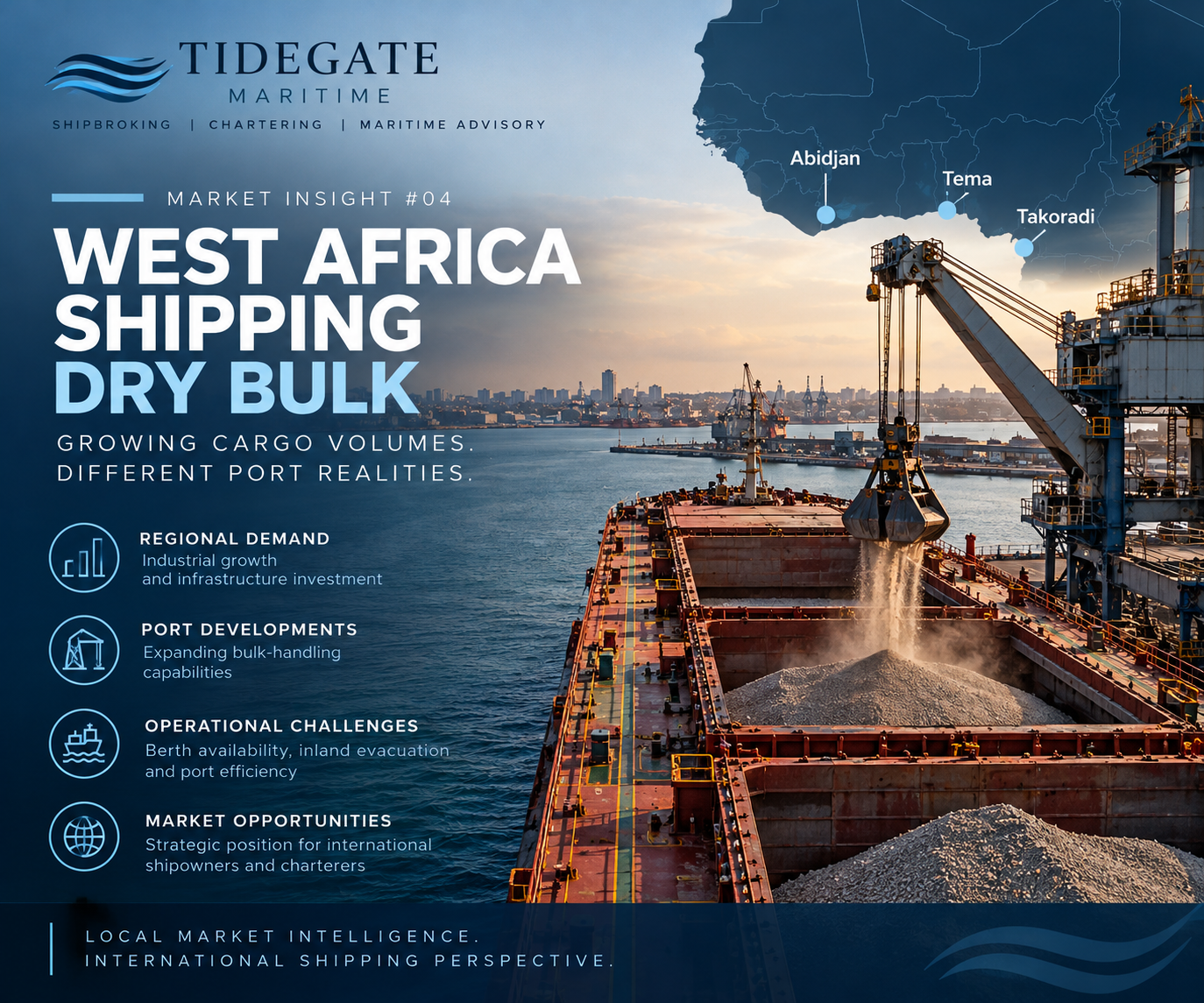
West Africa's maritime sector continues to evolve, supported by industrial development, port infrastructure investment and changing regional trade flows.
For the dry bulk market, recent developments in Côte d'Ivoire and Ghana highlight how infrastructure expansion and operational constraints can create different trading conditions across neighbouring ports.
ABIDJAN | Expanding Bulk-Handling Capabilities
The Port of Abidjan recorded 46.9 million tonnes in total net cargo traffic in 2025, representing a 17% increase compared with 2024.
Beyond overall traffic growth, the port has demonstrated new capabilities in large-scale bulk handling.
In June 2025, Abidjan's bulk terminal received the MV DEYI DILIGENCE, a Capesize bulk carrier measuring approximately 289 metres, carrying 126,463 MT of clinker.
This milestone illustrates the evolution of Abidjan's bulk-handling infrastructure and its ability to accommodate larger vessels.
TEMA | Clinker Imports and Operational Constraints
In Ghana, increasing clinker imports have placed additional pressure on port operations at Tema.
In September 2026, Ghanaian transport authorities announced measures aimed at improving clinker discharge operations and reducing congestion.
These measures included:
- Dredging of dedicated bulk berths.
- Additional berthing capacity.
- Improved vessel scheduling arrangements.
- Consideration of Takoradi as an alternative discharge port.
- Greater attention to inland cargo evacuation.
These developments demonstrate that increasing maritime capacity requires coordination between terminal infrastructure, vessel arrivals and landside logistics.
MARKET IMPLICATIONS | A More Differentiated Operating Environment
The developments in Abidjan and Tema illustrate an important evolution in West African dry bulk shipping.
While regional infrastructure is expanding, operational conditions remain specific to individual ports and terminals.
For Owners, Operators and Charterers, differences in berth availability, permissible draft, discharge performance and inland evacuation capacity can materially affect:
- Vessel deployment and voyage planning.
- Port turnaround times.
- Demurrage exposure.
- Freight economics.
- Discharge port selection.
As West African industrial demand and maritime infrastructure evolve, understanding these local operating conditions remains essential when assessing regional trading opportunities.
THE TIDEGATE PERSPECTIVE
West Africa should not be approached as a single, uniform shipping market.
Each port presents its own combination of cargo demand, infrastructure capabilities and operational constraints.
Based in Abidjan, Tidegate Maritime connects international shipping markets with regional cargo opportunities and local maritime intelligence across West and Central Africa.
Local Market Intelligence. International Shipping Perspective.