
West Africa's Changing Tanker Flows
Nigeria's refining growth is changing the geography of product tanker employment — new supply, new routes, new positioning.
Tidegate Maritime | Market Intelligence
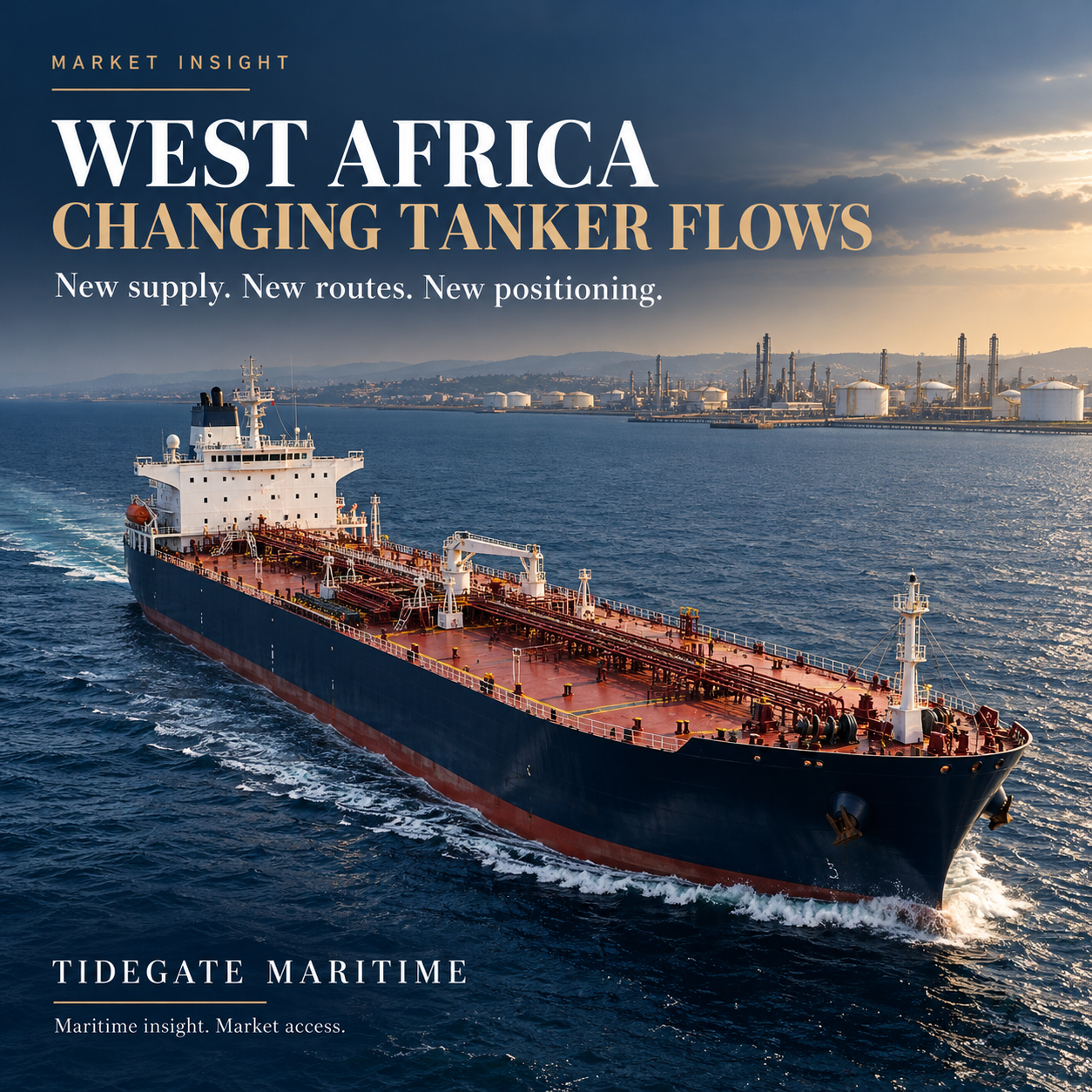
Nigeria's refining growth is changing the geography of product tanker employment.
According to the U.S. EIA, citing Vortexa data, Nigeria exported around 350,000 bpd of petroleum products by sea in Q2 2026, against an annual average of 46,000 bpd in 2023. Seaborne imports fell from nearly 400,000 bpd in 2023 to below 130,000 bpd in Q2 2026.
For owners and charterers, the story is not just volume.
A GROWING LOADING HUB
Expanding Nigerian supply gives owners a stronger cargo origin to consider when positioning tonnage in the Atlantic basin.
SHORTER AND LONGER HAULS AT THE SAME TIME
Replacing a European cargo bound for West Africa with Nigerian supply shortens the voyage. Meanwhile, Nigerian exports to Europe reached around 130,000 bpd in Q2 2026, supporting longer-haul tanker employment alongside regional trade. The net tonne-mile effect depends on the route mix.
COASTAL TRADE IS GROWING FAST
Shipments between Nigerian ports reached about 211,000 bpd in Q2 2026, compared with an annual average of 81,000 bpd in 2025. This creates coastal tanker opportunities, with vessel requirements shaped by parcel sizes, draft limits and terminal restrictions. Access also depends on applicable cabotage rules.
THE TIDEGATE PERSPECTIVE
This is a redistribution of tanker opportunities, with different effects across routes and vessel segments. Part of the Q2 surge also coincided with supply disruption through the Strait of Hormuz. A blanket bullish call on freight would overlook both the changing route mix and the circumstances supporting those flows.
What to watch: refinery reliability, export destinations, parcel sizes, turnaround times and the normalisation of flows through Hormuz.
For West African shipping, where the next cargo loads may become as important as where it discharges.
Maritime insight. Market access.